
 Oilfield service
Coiled Tubing
Coiled tubing cleanouts, nitrogen lifting, stimulation and milling, planned with force, hydraulic and well performance modelling so the treatment fits the real problem.
Oilfield Services
Pre-deployment inspection and pressure testing of well intervention equipment, so faults are found in the test bay, not on the well.
Overview
Pressure control equipment (PCE) is what stands between the crew and the well during an intervention. Lubricators, blowout preventers, stuffing boxes and grease heads are moved, rigged up and stressed on every job, and damage from handling or transport does not wait for the annual test.
Our NDT and PCE Integrity Testing service inspects and tests this equipment before it is deployed. Non-destructive testing finds cracks, corrosion and material fatigue without damaging the component, and pressure and function tests confirm it will hold and operate as designed.
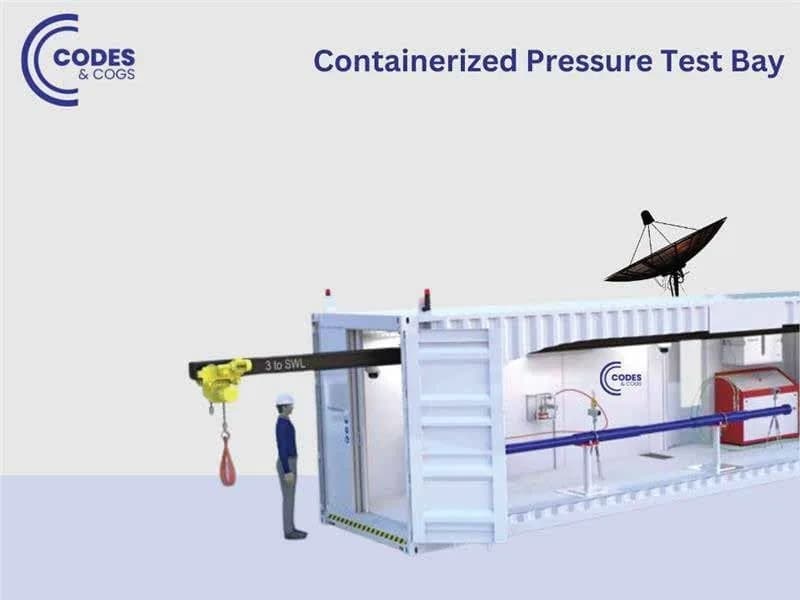
The work is run from our Containerised Pressure Test Bay, a transportable test facility with an overhead hoist and satellite communications for sharing results. We set out our approach in the whitepaper Advancing Pressure Control Equipment (PCE) Integrity Testing for Well Intervention Operations, available on our Resources page. The same pressure-control discipline carries straight into the gas capture and compression systems we install.
Capabilities
Inspection, pressure testing and function testing of lubricators, BOPs, stuffing boxes, grease heads and related rig-up equipment before it goes to the well.
Low and high pressure hold tests to the required test pressure, plus function tests of rams and valves, with results recorded for each component.
Wall thickness measurement to detect corrosion, erosion and material loss in lubricators, tubulars and wellhead components.
Typical surface methods such as magnetic particle and dye penetrant inspection to reveal cracks and fatigue at threads, welds and high-stress areas.
Close examination of seal faces, threads, elastomers and connections, with dimensional checks against the acceptance criteria for each item.
A shipping-container test bay with a 3-tonne SWL overhead hoist and a satellite communications dish, so testing can be set up close to operations and results shared quickly.
Results recorded for each component, building a history that supports certification, maintenance planning and audits.
How we work
We list the equipment to be deployed, its pressure rating, service history and the test requirements for the job.
Each component is cleaned and inspected visually, then examined with the NDT methods its condition and service call for.
Equipment is pressure tested and function tested in the test bay, with every result recorded.
Equipment that passes is released with its test record. Anything that fails is quarantined with clear findings for repair or replacement.
Outcomes
Defects are found in the test bay rather than during rig-up or operations, protecting crew, assets and the environment.
Equipment problems caught before mobilisation avoid stand-by time and repeat trips to location.
Documented inspections and tests help you meet industry standards and your own integrity management requirements.
A test history for each component shows wear trends, so repairs and replacements can be planned rather than forced.
Deliverables
FAQs
Not covered here? Email our team and an engineer will answer.
Annual certification shows the equipment was sound on the day it was tested. Transport, handling and repeated use can damage it in between. Pre-deployment checks catch that damage before it matters. Our whitepaper sets out the case in detail.
The method depends on the component and the defect being looked for. Typical techniques include ultrasonic thickness testing, magnetic particle inspection, dye penetrant inspection and visual inspection.
Advancing Pressure Control Equipment (PCE) Integrity Testing for Well Intervention Operations is available to download from our Resources page.
The test bay is containerised so that it can be transported. Send us your location and equipment list and we will confirm the logistics.
Keep exploring
Oilfield serviceCoiled tubing cleanouts, nitrogen lifting, stimulation and milling, planned with force, hydraulic and well performance modelling so the treatment fits the real problem.
 Oilfield service
Wellbore monitoring and data collection, setting and retrieving downhole devices, integrity checks, production optimisation and fishing, led by slickline specialists with decades in the field.
 Energy solution
EPC and installation of flare gas recovery, conditioning, gas-to-power, CNG, LPG/NGL and small-scale LNG units, with hybrid solar and battery systems, commissioning and O&M.
Start a project
Tell us where the gas is and what you need. Our engineers will come back with a practical first assessment and a clear next step.